
Estimated reading time: 11 minutes
Key Takeaways
- What students call the NLE exam Pakistan for foreign medical graduates is officially the National Registration Examination (NRE), held by PM&DC under Section 18 of the PM&DC Act 2022. Passing it is mandatory for a full licence.
- It has two parts. Step-I (theory): 200 computer-based MCQs, 70% clinical sciences and 30% basic sciences, pass mark 60%, no negative marking. Step-II (Clinical Skills Examination, CSE): OSCE-style, about 3.5 hours, 20 stations of 8 minutes each, pass mark 60%, with three mandatory stations that must each be passed.
- There is no limit on attempts. A Step-I pass is valid for five years; after three consecutive CSE failures you must retake both parts.
- 2026 dates: NRE-I on 17 May and 11 October; NRE-II on 27–28 June and 4–5 July, then 28–29 November and 5–6 December.
- Eligibility is not automatic. You need PM&DC student registration from before you left, an ECFMG-listed university, and the academic thresholds. Some graduates also need the separate NEB equivalence exam first.
- The syllabus is public. Study Medicine (52 MCQs) and Surgery (48) hardest; those two also supply 14 of the 20 CSE stations.
Table of Contents
- NLE, NRE, NEB: what the names mean
- Who must sit the NRE
- Eligibility conditions
- Step-I: the theory paper
- Step-II: the Clinical Skills Examination
- Passing rules, validity and attempts
- 2026 exam calendar
- Registration and fees
- Provisional registration and house job
- How to prepare from year one
- Country-by-country notes
- FAQ
- Bottom line
The NLE exam Pakistan for foreign medical graduates is the single biggest unknown for families sending a child abroad for MBBS. Agents mention it in passing; PM&DC treats it as the gate. This guide is built from PM&DC’s own NRE Standard, Structure and Syllabus 2024 notification, its policy for students going abroad, and the 2026 exam notices.
If you are planning MBBS in Russia, Kazakhstan, Kyrgyzstan, Uzbekistan or Azerbaijan, read this before you pay a first-year fee. The NLE exam Pakistan for foreign medical graduates decides whether that degree becomes a licence.
NLE, NRE, NEB: what the names mean
- NLE (National Licensing Examination): the name used under the former Pakistan Medical Commission. Students and coaching centres still say NLE.
- NRE (National Registration Examination): the current official name under the PM&DC Act 2022, per the 2024 notification. NLE and NRE mean the same exam.
- NEB (National Equivalence Board): a separate equivalence exam for some foreign graduates, scheduled in 2026 for 16 May through Rawalpindi Medical University, per Medical News Pakistan. Many graduates confuse NEB and NRE and delay their own registration, per the same report.
Who must sit the NRE
Every Pakistani who completes MBBS or an equivalent degree abroad and wants a full licence to practise as a general practitioner in Pakistan. PM&DC states that passing both the theory and clinical components is mandatory for a full licence, per the notification, and its September 2025 press release describes the registration examination as mandatory for all foreign medical graduates under the law, comparing it to USMLE, PLAB and MCCQE, per the press release.
Eligibility conditions
Three layers of eligibility apply:
- The exam rule. The 2024 standard says candidates must have graduated from PM&DC-approved foreign medical colleges with an MBBS/MD or equivalent and hold a provisional licence, per the notification. Since September 2025, only graduates of ECFMG-listed institutions are eligible to appear, and graduates of non-recognised institutions get provisional registration only after passing, per the press release.
- The pre-departure rules. Students admitted abroad from Session 2024-25 must have 60% FSc, 50% MDCAT, the free PM&DC Student Registration Certificate from srf.pmdc.pk obtained before leaving, a program of at least 6,200 hours over five years, and a multiple entry and exit visa for the whole program to show at NRE application. Failing any condition makes the candidate ineligible to sit the NRE, per the policy. See our PMDC policy guide.
- Equivalence where required. Some graduates must clear the NEB first; PM&DC publishes who needs equivalence, per Medical News Pakistan.

Step-I: the theory paper
From the official standard:
- 200 MCQs, computer based, targeting higher cognition and application of knowledge
- 30% basic sciences (60 MCQs): Applied Pathology 11, Applied Anatomy 11, Applied Physiology 10, Clinical Pharmacology 8, Applied Biochemistry 6, Community Medicine 6, Forensic Medicine and Toxicology 4
- 70% clinical sciences (140 MCQs): Medicine and Allied 52, Surgery and Allied 48, Obstetrics and Gynaecology 14, Paediatrics 14, Ophthalmology 6, ENT 6
- Pass mark 60%, standard-set using the Angoff method, no negative marking
Only candidates who pass Step-I proceed to the CSE.
Step-II: the Clinical Skills Examination
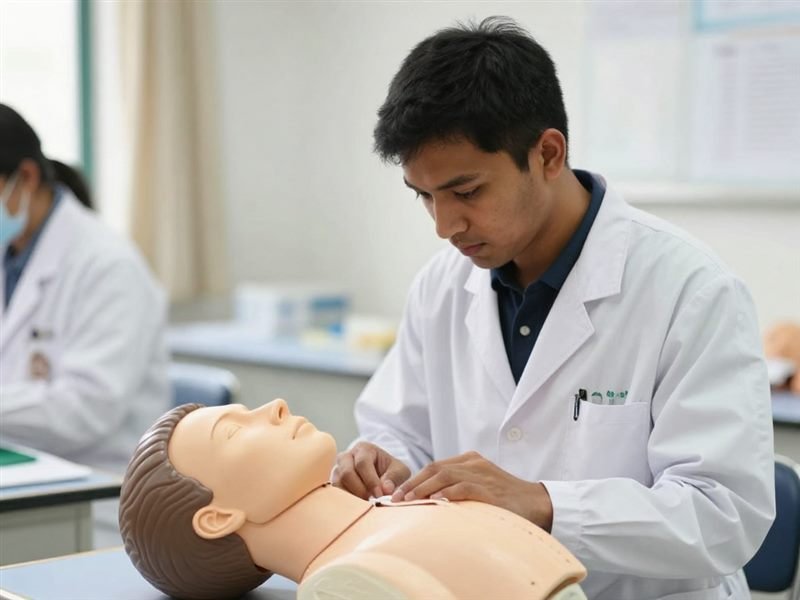
The CSE assesses the skills of a safe general physician: interpreting clinical and diagnostic data, forming a diagnosis, planning management, examination and key procedures, per the notification. Structure:
- OSCE format, about 3 hours 30 minutes including briefing
- 20 stations: Medicine 7, Surgery 7, Obstetrics and Gynaecology 2, Paediatrics 2, Ophthalmology 1, ENT 1
- 8 minutes per station plus 2 minutes changeover
- Pass mark 60% overall, and all three mandatory stations must be passed; 60% overall with one mandatory station failed is a fail
- PM&DC may change duration, station count or pass mark with at least 12 weeks’ notice on its website
Appendix 3 of the standard lists the 43 competencies the CSE draws on, from history-taking and BLS to cannulation, catheterisation, ECG, X-ray interpretation and informed consent. Coaching guides describe the same OSCE structure, per HMI Academy and Multipotent Medverse.
Passing rules, validity and attempts
- Theory and CSE must be passed separately.
- No cap on the number of attempts at the complete NRE.
- A Step-I pass is valid for five years; the CSE must be passed within that window.
- Pass theory but fail CSE: re-register for the CSE only.
- After three consecutive CSE failures, sit both components again.
All from the 2024 standard. The exam is held at least twice a year at multiple centres in Pakistan.
2026 exam calendar
- NEB: Saturday 16 May 2026, per Medical News Pakistan
- NRE-I: Sunday 17 May 2026 (registration 16–29 April) and 11 October 2026, per Dental News Pakistan
- NRE-II: 27–28 June and 4–5 July 2026; then 28–29 November and 5–6 December 2026, per Dental News Pakistan
Dates shift each year. Confirm on pmdc.pk.
Registration and fees
Register through the PM&DC doctor portal under “Pak National Foreign Graduates Registration” at portal.pmdc.pk, upload documents, pay, and download the roll number slip. Step-II opens only after a Step-I pass shows in your dashboard, per a candidate guide, which also quotes fees of roughly PKR 20,000 to 25,000 per step. Confirm the current fee on the portal. Registration volumes are large: one guide cites more than 5,000 registered for NRE-I in 2025, per Adnan Mahdi MD.
Provisional registration and house job
Graduates of institutions duly recognised by PM&DC may be granted provisional registration before the NRE, allowing a house job, but must still pass the NRE for a full licence. All others receive provisional registration only after qualifying, per the September 2025 press release. That release followed a dispute in which PM&DC said about 700 graduates were pending while graduate groups said about 3,000, per the Express Tribune.

How to prepare from year one
- Download the syllabus now. The PM&DC syllabus page has the medical and dental versions. Read Appendix 2 (clinical) and Appendix 3 (skills).
- Map your foreign curriculum against it. Central Asian and Russian programs often teach forensic medicine, community medicine and Pakistani health-system topics lightly; those are on the paper.
- Weight your time by MCQ count. Medicine 52 and Surgery 48 are half the paper.
- Practise MCQs that test application, not recall; the standard says the paper targets higher cognition.
- Log clinical skills during internship. The CSE competencies are ward skills. Keep a signed procedure log.
- Learn Pakistani drug names, guidelines and common local diseases: dengue, malaria, typhoid, TB, thalassemia, organophosphate and wheat-pill poisoning all appear in the syllabus.
- Do mock OSCEs with peers; timed 8-minute stations, per the advice in DMLEC.
Country-by-country notes
- Russia: clinical years in Russian; make sure you can present cases in English for the CSE.
- Kyrgyzstan and Kazakhstan: PM&DC named Central Asian republics among the main sources of graduates affected by its 2025 registration decisions, per the press release. Verify ECFMG listing before enrolling.
- Uzbekistan and Azerbaijan: smaller Pakistani cohorts; fewer NRE-specific coaching resources, so rely on the official syllabus.
FAQ
Is NLE the same as NRE?
Yes. NRE is the current official name under the PM&DC Act 2022.
What is the passing percentage?
60% in theory and 60% in the CSE including all three mandatory stations, per the standard.
How many attempts are allowed?
No limit, but three consecutive CSE failures mean retaking both parts.
Can I do a house job before passing?
Only if your institution is recognised by PM&DC and you are granted provisional registration; otherwise not until you pass, per the press release.
Is there negative marking?
No, in either component.
Bottom line
The NLE exam Pakistan for foreign medical graduates is not a formality. It is a 200-MCQ paper and a 20-station clinical exam with published weightings and a 60% bar, and it is only open to graduates who satisfied PM&DC’s conditions before they left. Treat the official standard as your study plan from first year, keep your documents and visas, and check pmdc.pk for each year’s dates.